欧洲的某个地方

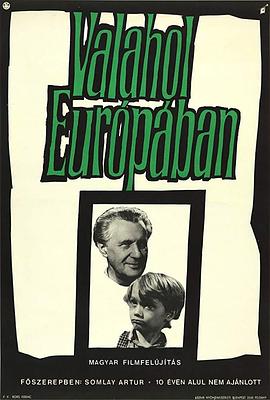
欧洲的某个地方

90.10万次播放 3分 1948

监制:暂无 / 主演:ArtúrSomlay/MiklósGábor/ZsuzsaBánki

Somewhere in the remote region, the war ends. In the midst of ruined cities and houses in the streets, in rural hamlets, everywhere where people still live, are children who have lost their homes and parents. Abandoned, hungry, and in rags, defenseless and humiliated, they wander through the world. Hunger drives them. Little streams of orphans merge into a river which rushes forward and submerges everything in its path. The children do not know any feeling; they know only the world of their enemies. They fight, steal, struggle for a mouthful of food, and violence is merely a means to get it. A gang led by Cahoun finds a refuge in an abandoned castle and encounters an old composer who has voluntarily retired into solitude from a world of hatred, treason, and crime. How can they find a common ground, how can they become mutual friends The castle becomes their hiding place but possibly it will also be their first home which they may organize and must defend. But even for this, the price will be very high.  To this simple story, the journalist, writer, poet, scriptwriter, movie director, and film theoretician Béla Balázs applied many years of experience. He and the director Géza Radványi created a work which opened a new postwar chapter in Hungarian film. Surprisingly, this film has not lost any of its impact over the years, especially on a profound philosophical level. That is to say, it is not merely a movie about war; it is not important in what location and in what period of time it takes place. It is a story outside of time about the joyless fate of children who pay dearly for the cruel war games of adults.  At the time it was premiered, the movie was enthusiastically received by the critics. The main roles were taken by streetwise boys of a children's group who created their roles improvisationally in close contact with a few professional actors, and in the children's acting their own fresh experience of war's turmoil appears to be reflected. At the same time, their performance fits admirably into the mosaic of a very complex movie language. Balázs's influence revealed itself, above all, in the introductory sequences an air raid on an amusement park, seen in a montage of dramatic situations evoking the last spasms of war, where, undoubtedly, we discern the influence of classical Soviet cinematography. Shooting, the boy's escape, the locomotive's wheels, the shadows of soldiers with submachine guns, the sound of a whistle—the images are linked together in abrupt sequences in which varying shots and expressive sharp sounds are emphasized. A perfectly planned screenplay avoided all elements of sentimentality, time-worn stereotypes of wronged children, romanticism and cheap simplification. The authors succeeded in bridging the perilous dramatic abyss of the metamorphosis of a children's community. Their telling of the story (the scene of pillaging, the assault on the castle, etc) independently introduced some neorealist elements which, at that time, were being propagated in Italy by De Sica, Rossellini, and other film artists. The rebukes of contemporary critics, who called attention to formalism for its own sake have been forgotten. The masterly art of cameraman Barnabás Hegyi gives vitality to the poetic images. His angle shots of the children, his composition of scenes in the castle interior, are a living document of the times, and underline the atmosphere and the characters of the protagonists. The success of the picture was also enhanced by the musical art of composer Dénes Buday who, in tense situations, inserted the theme of the Marseilaise into the movie's structure, as a motive of community unification, as an expression of friendship and the possibility of understanding.  Valahol Europaban is the first significant postwar Hungarian film. It originated in a relaxed atmosphere, replete with joy and euphoria, and it includes these elements in order to demonstrate the strength of humanism, tolerance, and friendship. It represents a general condemnation of war anywhere in the world, in any form.
简介
热门推荐

口碑剧集和同题材热播内容继续追

  • 60.37万次播放
    莫拉德

    古老广袤的非洲大陆,千百年流传着一个极其残酷的习俗,这里的女孩长到一定年龄时就要接受割礼。所谓割礼,即割除女性部分或者全部的阴核以及小阴唇,再用一般针线或者荆棘缝合。全程没有任何麻醉和消毒措施,受礼者痛苦至极,且要承受着破伤风感染、艾滋病传染甚至丧命的危险。  克里(Fatoumata Coulibaly 饰)是一位聪明贤良的女性,她对年轻时接受割礼的痛苦经历记忆犹新,而且在接下来的几十年里,她无时无刻不在承受着伤口为精神和肉体带来的双重折磨。克里不愿女儿再承受这般磨难,于是不顾一切阻止女儿接受割礼。她的举动遭到村里人的质疑和职责,来自周遭的压力越来越大……  本片荣获2004年戛纳电影节天主教人道精神奖的特别提名奖和一种关注奖、2005年马尼拉国际电影节最佳女主角(Fatoumata Coulibaly)。

    2004 / 其它

  • 36.60万次播放
    马背法庭之阿巴嘎黑马

    在锡林郭勒盟阿巴嘎旗北部的草原上,有着优良传统的“阿巴嘎黑马”,在面临着种群减少的危险。牧民乌力罕与宝力道因为一匹生个子“阿巴嘎黑马”的归属权,闹得不可开焦,最终上了法庭……

    2021 / 大陆

  • 5.75万次播放
    照亮黑暗

    剧情简介暂缺,敬请期待

    2026 / 印度

  • 70.89万次播放
    味道男女

    故事发生在2008年,为迎接奧运,全球华人举办厨艺大赛。代表大陆地区参赛的壹品楼特级厨师鲍一品(倪大宏 饰)暗自焦虑,因为他异于常人的味觉功能正在退化,而能让腐朽化神奇的御龙珠早在数年前被其师兄盗走。决赛临近,全球顶级厨师汇聚北京,这时,一个姓白(张超 饰)的青年人出现在壹品楼,并同鲍一品的女儿春蕾(赵柯 饰)及服务员蓉蓉(李奕娴 饰)发生了感情纠葛,春蕾的真正用意在于从小白手中取回自家祖传的宝贝御龙珠。不料事与愿违,捷克厨师马三决赛前从小白手中偷走了御龙珠,一连串的蹊跷事发生了......

    2008 / 大陆

  • 26.44万次播放
    欢乐糖果屋

    著名糖果商威利·旺克(吉恩·怀尔德 Gene Wilder 饰)公布了一条让世界震惊的喜讯,他将挑选五名幸运儿参观自己的糖果厂,其中一人将成为终身享用“旺克巧克力”特权的人。出身贫寒的小男孩查理·

    1971 / 美国

  • 29.64万次播放
    雨季过后

    The film depicts a coming-of-age story centered on the two sugar babies, Kotone, who is unemployed, and Sakura, a college student, in the coronavirus pandemic, as they try their best to live at the mercy of frivolous men.

    2024 / 日本

欧洲的某个地方

首播时间:1948

更新状态:

监制:暂无

主演:ArtúrSomlay/MiklósGábor/ZsuzsaBánki

播放量:90.10万

剧情简介
Somewhere in the remote region, the war ends. In the midst of ruined cities and houses in the streets, in rural hamlets, everywhere where people still live, are children who have lost their homes and parents. Abandoned, hungry, and in rags, defenseless and humiliated, they wander through the world. Hunger drives them. Little streams of orphans merge into a river which rushes forward and submerges everything in its path. The children do not know any feeling; they know only the world of their enemies. They fight, steal, struggle for a mouthful of food, and violence is merely a means to get it. A gang led by Cahoun finds a refuge in an abandoned castle and encounters an old composer who has voluntarily retired into solitude from a world of hatred, treason, and crime. How can they find a common ground, how can they become mutual friends The castle becomes their hiding place but possibly it will also be their first home which they may organize and must defend. But even for this, the price will be very high.  To this simple story, the journalist, writer, poet, scriptwriter, movie director, and film theoretician Béla Balázs applied many years of experience. He and the director Géza Radványi created a work which opened a new postwar chapter in Hungarian film. Surprisingly, this film has not lost any of its impact over the years, especially on a profound philosophical level. That is to say, it is not merely a movie about war; it is not important in what location and in what period of time it takes place. It is a story outside of time about the joyless fate of children who pay dearly for the cruel war games of adults.  At the time it was premiered, the movie was enthusiastically received by the critics. The main roles were taken by streetwise boys of a children's group who created their roles improvisationally in close contact with a few professional actors, and in the children's acting their own fresh experience of war's turmoil appears to be reflected. At the same time, their performance fits admirably into the mosaic of a very complex movie language. Balázs's influence revealed itself, above all, in the introductory sequences an air raid on an amusement park, seen in a montage of dramatic situations evoking the last spasms of war, where, undoubtedly, we discern the influence of classical Soviet cinematography. Shooting, the boy's escape, the locomotive's wheels, the shadows of soldiers with submachine guns, the sound of a whistle—the images are linked together in abrupt sequences in which varying shots and expressive sharp sounds are emphasized. A perfectly planned screenplay avoided all elements of sentimentality, time-worn stereotypes of wronged children, romanticism and cheap simplification. The authors succeeded in bridging the perilous dramatic abyss of the metamorphosis of a children's community. Their telling of the story (the scene of pillaging, the assault on the castle, etc) independently introduced some neorealist elements which, at that time, were being propagated in Italy by De Sica, Rossellini, and other film artists. The rebukes of contemporary critics, who called attention to formalism for its own sake have been forgotten. The masterly art of cameraman Barnabás Hegyi gives vitality to the poetic images. His angle shots of the children, his composition of scenes in the castle interior, are a living document of the times, and underline the atmosphere and the characters of the protagonists. The success of the picture was also enhanced by the musical art of composer Dénes Buday who, in tense situations, inserted the theme of the Marseilaise into the movie's structure, as a motive of community unification, as an expression of friendship and the possibility of understanding.  Valahol Europaban is the first significant postwar Hungarian film. It originated in a relaxed atmosphere, replete with joy and euphoria, and it includes these elements in order to demonstrate the strength of humanism, tolerance, and friendship. It represents a general condemnation of war anywhere in the world, in any form.
选集
1.230712s